


Artist Spotlight · Part 1 · Beehaya Studio
R. Kikuo Johnson: Biography, Illustration Style and Best Works
Some images pull us into a life before we have read a single word of the story. A passing glance, a pause on a subway staircase, a pile of gear stacked beside a car: any of these can be the first line of a narrative that each viewer finishes in their own head. R. Kikuo Johnson is an illustrator who knows exactly how to find those moments.

In the first instalment of our Artists of the World series on the Beehaya Studio blog, we trace the career of this American artist, from his early years on the island of Maui to his graphic novels and his much-admired New Yorker covers. This is more than a biography. We want to understand what gives Johnson’s images their identity, and why his work rewards anyone who cares about character design and visual storytelling.
Key takeaways
- R. Kikuo Johnson was born in 1981 on Maui, Hawaii, and graduated from the Rhode Island School of Design in 2003.
- His style is graphic, narrative-driven and built on careful observation, with colour chosen for mood rather than decoration.
- Three books define his bookshelf: Night Fisher (2005), The Shark King (2012) and No One Else (2021).
- His New Yorker covers show how a single frame can carry a complete story.
- In 2023 he received a Whiting Award and was, according to the foundation and his official biography, the first cartoonist to do so.
Who is R. Kikuo Johnson?
R. Kikuo Johnson is an American illustrator, cartoonist and graphic novelist, born in 1981 on the Hawaiian island of Maui. His work has appeared in books, magazines, advertising and visual media, but his name is most closely tied to his graphic narratives and to his covers for The New Yorker.
Johnson graduated from the Rhode Island School of Design (RISD) in 2003. According to his official biography, he also teaches at the School of Visual Arts in New York. His published client list is strikingly broad, running from Apple and Nike to The New York Times and The New Yorker. Yet the names alone are not what make his career interesting. What stands out is the consistency of his storyteller’s eye across every medium he touches.
Kikuo Johnson from Maui to New York: the roots of a visual voice
To understand Johnson’s work, start with Maui. The island is not just his birthplace; it keeps returning to the settings of his stories. In a New Yorker conversation about his cover Safe Travels, he describes a childhood spent exploring Hawaiian beaches and forests. Those experiences resurface in the landscapes, weather and environmental detail of his illustrations.
His love of visual storytelling began early. By his own account, he started a comic called Windman while still in elementary school. That instinct never left him. Whether he is designing a magazine cover or a full-length graphic novel, he tends to focus on the relationship between character and situation rather than on decorative effect.
Moving between Hawaii and New York has placed two very different geographies inside his work: nature and memory on one side, the small details of a crowded city on the other. You can see that contrast in his choice of subjects, from a family story set on Maui to an ordinary Brooklyn commute.
R. Kikuo Johnson’s illustration style: detail in service of story
Johnson’s style is best described as graphic, narrative-driven and rooted in close observation. His lines are readable, his forms are drawn with confidence, and his colour sets the mood of a scene instead of competing for attention. These traits do not appear identically everywhere, of course. The visual language of a black-and-white graphic novel is very different from that of a full-colour magazine cover.
Characters who speak through their bodies
In Johnson’s images, body language often matters as much as facial expression. The curve of a character’s back, the distance between two people or the direction of a glance tells us about their relationship before anyone says a word. This attention to human behaviour is a reminder that character design is not simply about creating an appealing look. A character has to be believable inside a situation.
Compositions with a director’s eye
He uses the frame to guide the viewer’s attention with real skill. In some pieces the eye lands first on a single main element, and the surrounding details then complete the meaning. At times he pulls back to show how a figure relates to a place; at others he zooms in on a simple moment so that its hidden humour or tension can surface.
Limited palettes, deliberate choices
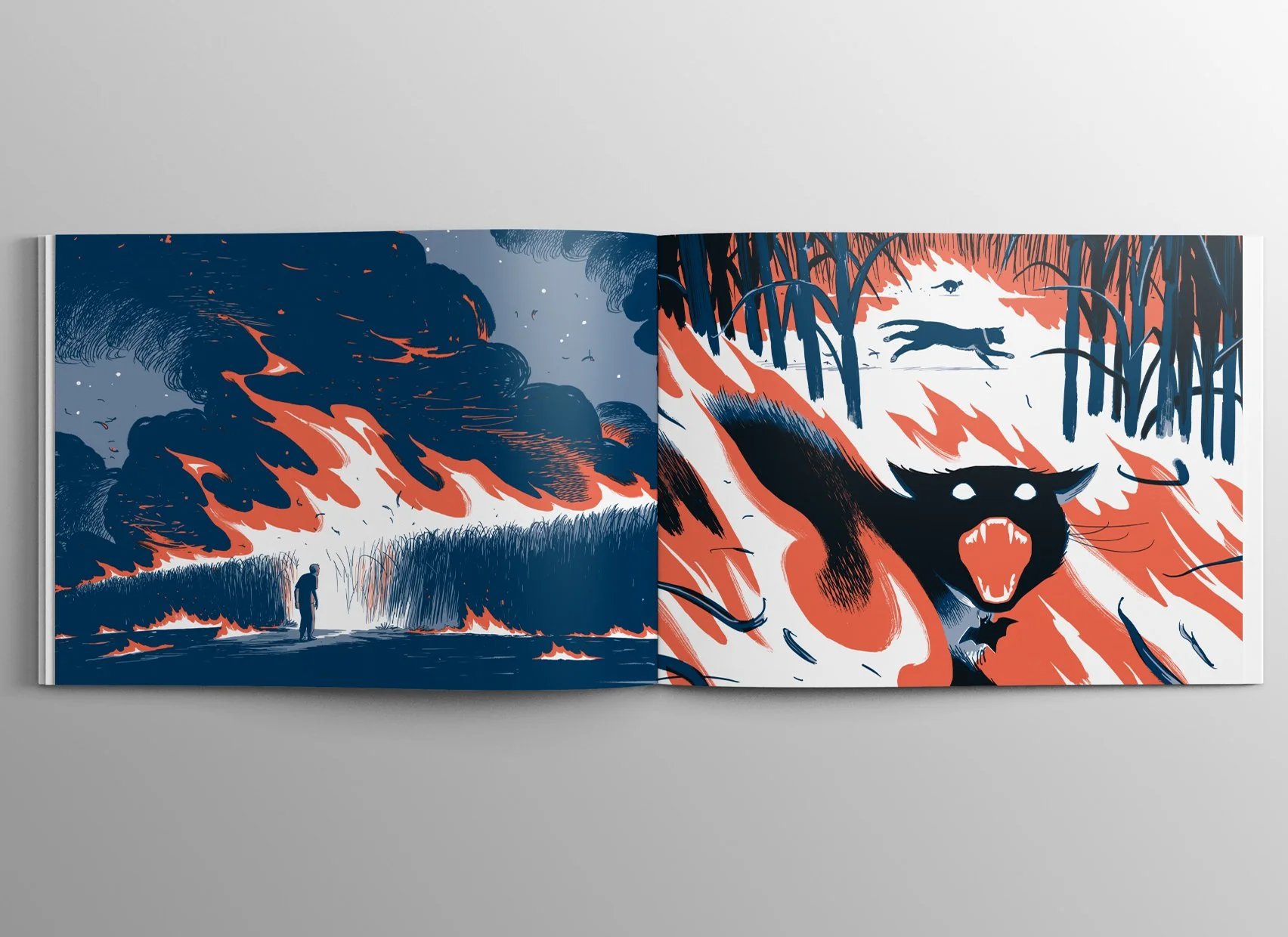
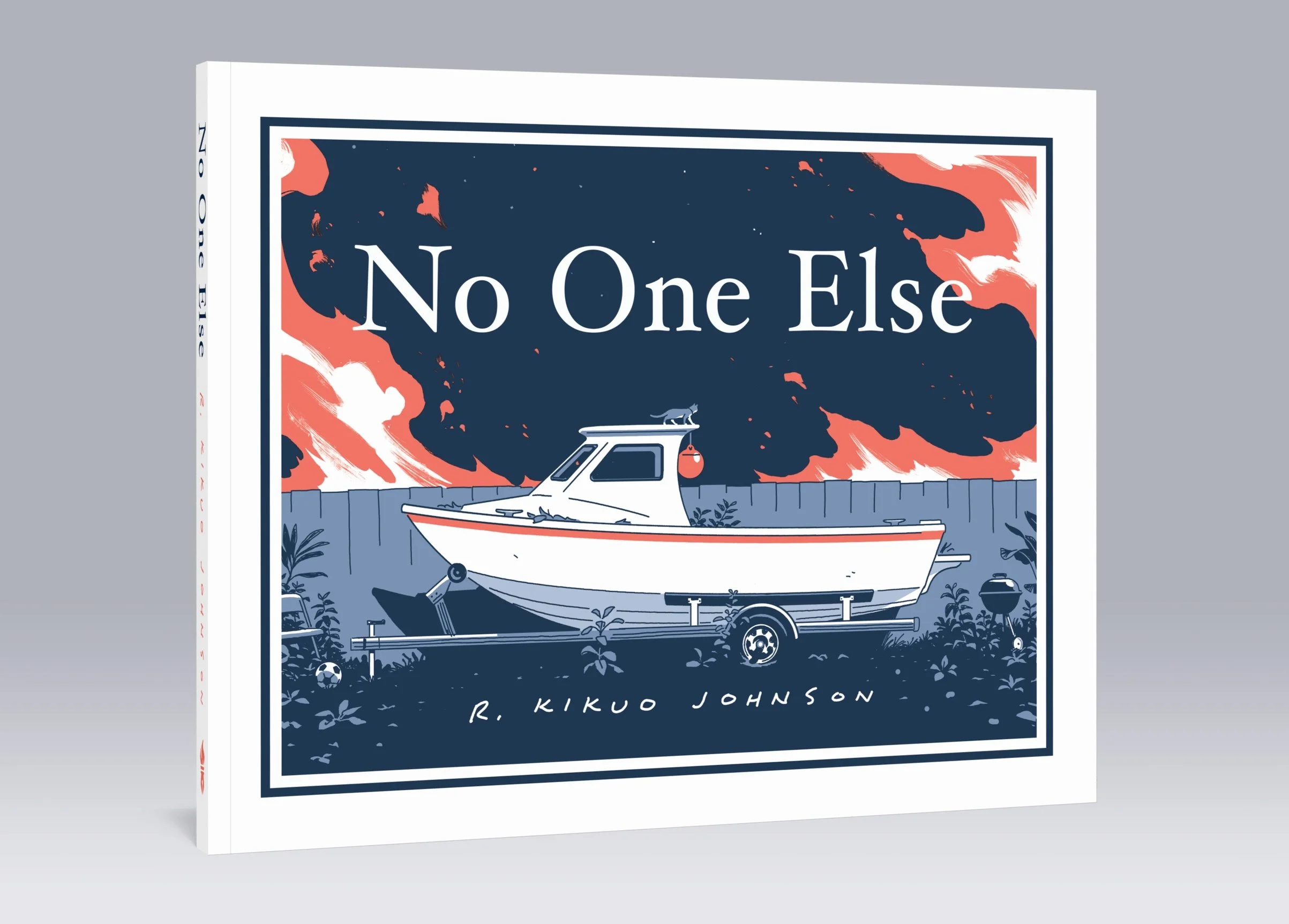
In the graphic novel No One Else, a restrained palette becomes a storytelling decision. Deep blues paired with warm oranges hold the emotional atmosphere together and help the eye travel from panel to panel. Some of his New Yorker covers, by contrast, use a wider range of colour. What stays constant is intentionality, not loyalty to one signature palette.
Three essential books in R. Kikuo Johnson’s career
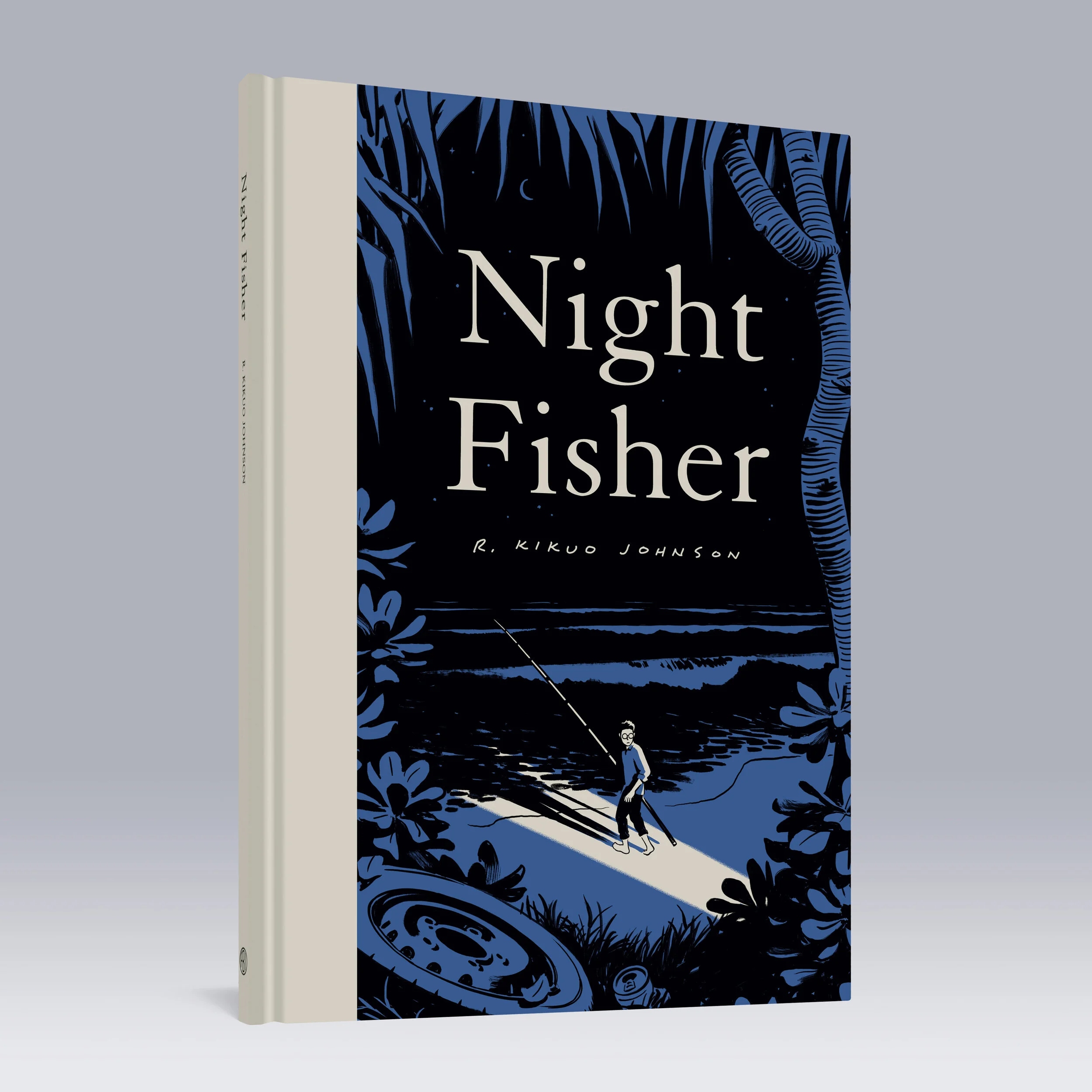
Night Fisher (2005): a difficult passage out of adolescence
Johnson’s first graphic novel, Night Fisher, follows two teenagers on Maui, Loren and Shane. Their friendship is tested as high school draws to a close, as they drift apart and as they become entangled in a criminal scheme. The book steps away from the postcard image of Hawaii and explores the relationships that grow more complicated beneath an apparently calm everyday surface.
Its black-and-white artwork, with its emphasis on atmosphere, light and body language, suits the tone of the story. The book earned Johnson a Harvey Award for Best New Talent in 2006, and a revised edition was published by Fantagraphics in 2021.
The Shark King (2012): a legend for younger readers
In The Shark King, Johnson turns to a story inspired by Hawaiian myth. Its hero, Nanaue, is a boy wrestling with questions about family, identity and his father. The mythic setting let the artist embrace more dynamic scenes and livelier colour.
The book shows that an illustrator can adapt his visual language to a new audience without losing his storytelling craft. Drawing for children here does not mean simplifying the narrative. It means finding a clear, energetic way to tell it.

No One Else (2021): grief inside everyday chores
No One Else may be the clearest window onto Johnson’s humane way of seeing. Its central character, Charlene, is a nurse who works full time while caring for her son Brandon and her ailing father. A death in the family, the return of her brother Robbie and a run of seemingly small events at home push the characters to renegotiate their relationships.
The story’s strength lies in refusing to treat grief as one large, theatrical event. Absence is felt in a silent house, in routine comings and goings, and in the work that must still be done. By lingering on ordinary details and cutting unnecessary explanation, Johnson lets readers pick up the tension and emotion from between the panels.
Published in 2021, the book won the Los Angeles Times Book Prize in the graphic novel/comics category as well as an Ignatz Award. The LA Times prize appears under the 2021 prize year on some official pages and as a 2022 honour in the artist’s own list, but both refer to the same achievement.
Kikuo Johnson’s New Yorker covers: small stories in a single frame
Johnson’s work for The New Yorker shows another side of his talent: telling a story in one self-contained image. A magazine cover has little room to explain itself. The situation must read instantly, yet reward a second look with something more to discover.

In Safe Travels, the gear, the cars and the family members each carry a piece of the holiday story, an image fed by lived experience and memory. In A Mother’s Work, Johnson turns our attention to women for whom looking after other people’s children is part of the working day. Instead of a dramatic event, we get a situation seen every day and easily passed by.
For a wider view of his range, see Delayed (2021), an image about fear and insecurity set against the backdrop of anti-Asian attacks in the United States. Upstairs, Downstairs (2025) captures the familiar struggle of carrying a stroller down subway steps, and with it the difficulty of moving through a city with a small child. Together, these covers show humour, personal experience and social concern sharing one visual language.
R. Kikuo Johnson’s awards and professional standing
Over two decades, Johnson has been recognised for both his books and his editorial illustration. Among the most notable honours listed in his official biography:
- 2006: Harvey Award and Ross Manning Award for Night Fisher.
- 2013: Asian/Pacific American Award for Literature for The Shark King.
- 2018 and 2021: Gold Medals from the Society of Illustrators.
- 2022: Los Angeles Times Book Prize and Ignatz Award for No One Else.
- 2023: Whiting Award; according to the foundation and his official biography, the first cartoonist to receive it.
- 2025: another Gold Medal from the Society of Illustrators.
Awards alone cannot explain the quality of a body of work, but they show that Johnson’s storytelling has been noticed in two distinct arenas: illustrated literature and editorial illustration.
What artists can learn from R. Kikuo Johnson
The most important lesson in Johnson’s work may be that a good image is not necessarily busy or complicated; it is precise. Reaching that precision means deciding what to show, what to leave out and which details to save for the viewer’s second look.
Character designers can learn a great deal from his poses and from the way his figures relate to one another. Book illustrators will find plenty to study in the rhythm of his panels and the silences between story beats. And for artists working on covers, posters or advertising illustration, his New Yorker work is a clear demonstration that a well-judged visual idea can reach an audience without a long explanation.
Johnson is also an example of an artist who has balanced commercial projects with personal work. In a conversation about No One Else, he explains that he stepped back from commercial commissions for a time to work on the book, a difficult decision that let him finish a story he had carried for years. It is a useful reminder that professional growth is not only about taking on more jobs; the time an artist gives to a personal voice matters too.
Frequently asked questions about R. Kikuo Johnson
Who is R. Kikuo Johnson?
R. Kikuo Johnson is an American illustrator, cartoonist and graphic novelist born in 1981 on Maui, Hawaii. He is known for the graphic novels Night Fisher and No One Else and for his covers for The New Yorker.
What is R. Kikuo Johnson’s best-known book?
No One Else (2021) is widely regarded as his most acclaimed book. It won the Los Angeles Times Book Prize in the graphic novel/comics category and an Ignatz Award.
What is his art style?
His style is graphic and narrative-driven, with readable lines, confident forms and colour chosen to set mood. Body language and composition do much of the storytelling.
Which New Yorker covers has he illustrated?
Notable examples include Safe Travels (2018), Delayed (2021), A Mother’s Work (2024) and Upstairs, Downstairs (2025).
Where did he study?
He graduated from the Rhode Island School of Design in 2003 and, according to his official biography, teaches at the School of Visual Arts in New York.
Final thoughts
In R. Kikuo Johnson’s art, everyday life is never trivial. In a family holiday, an unfinished conversation or a brief moment on the street, he finds something worth telling. His real gift may be exactly this: seeing the story in moments that other people walk straight past.
This was the first article in Artists of the World on the Beehaya Studio blog, a series devoted to artists who have pushed the boundaries of illustration and visual storytelling in very different ways. Stay tuned for the next spotlight.
Inspired by this kind of storytelling clarity? Explore Beehaya Studio’s cartoon and character design work and see how we bring characters to life for brands.
See more of his work on the artist’s official website and in his archive at The New Yorker.
Sources and references
This article draws on the artist’s official biography, publisher information, and interviews and reports published in the sources below. The analysis of style and the reading of the artworks are the work of the Beehaya Studio editorial team.
- Official artist website — About: biography, activities and awards list on the artist’s official site.
- Official artist website — Books: book descriptions, cover images and sample pages.
- Fantagraphics — Night Fisher: synopsis and details of the revised edition.
- Fantagraphics — No One Else: synopsis and publication details.
- Whiting Foundation — Award profile: award announcement and selected works.
- The New Yorker — Safe Travels: conversation on inspiration from Maui’s nature.
- The New Yorker — A Mother’s Work: the cover and how it came about.
- The New Yorker — Delayed: social context and analysis of the cover.
- The New Yorker — Upstairs, Downstairs: conversation on parenting and city transit.
- The Comics Journal — In-depth interview: on the making of No One Else and memories of Hawaii.
- The New Yorker — Double-Parked: on his ideation process and balancing commissioned and personal work.
Author: Beehaya Studio editorial team · Artists of the World, Part 1. All artwork rights belong to R. Kikuo Johnson and the respective rights holders. Citing a source does not grant permission to republish; check image licensing before public release.
